RIEL News
Fire and biodiversity conservation in Great Sandy Desert
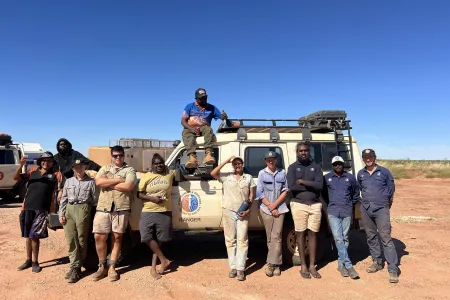
An ongoing project aims to understand how desert fire patterns have changed since colonisation, and how that affects the species which reside in the desert.
The ‘Improving desert fire management with culturally directed science’ project, which runs from 2023 to 2027 in Western Australia’s Great Sandy Desert, is using culturally directed science to improve understanding of how fire patterns in the desert have changed since European colonisation compared to the tens of thousands of years of Indigenous fire practice before that.
The work looks at how changes in fire patterns are affecting vegetation structure and native fauna, including culturally important species, from desert mice and marsupial moles to snakes and goannas.
The team includes RIEL’s Prof Sarah Legge, Prof Sam Banks, Prof Brett Murphy and Dr Kristina Macdonald, alongside members of the Karajarri, Ngurrara, Nyangumarta, and Ngururrpa rangers, and staff of Environs Kimberley and the Indigenous Desert Alliance. In 2024 the team also gained PhD candidate Stephanie Lee.
By the end of 2024, team members had published an initial pilot study in the journal Wildlife Research, along with an article on The Conversation website to share the work with a wider audience.
Rangers, researchers, and research partners carried out three field trips for data collection in the Great Sandy Desert over the same year. Nyangumarta rangers Vernon Bellou and Denzel Hunter said they enjoyed getting out to the desert, being on Country, and figuring out if fire management efforts are helping small animals.
“It’s really important for rangers to get out on Country and stay connected, and this work helps them do that,” said senior Nyangumartu woman Janey Wright.
Over time, the project expects to document fire patterns, undertake further fieldwork to understand the effects on native fauna, and help inform future fire management plans and conservation management.
This project is funded by an Australian Research Council Linkage grant.
This story was originally published in RIEL Annual Report 2024
Related Articles
Project examines fisheries and aquaculture work through gender lens
Nilanjana Biswas’s PhD project explores the under-researched role of women in the NT’s commercial seafood sector. Using a gender lens and mixed methods, it examines historical contributions, structural barriers, and policy impacts, making it one of Australia’s first studies in this field.
Read more about Project examines fisheries and aquaculture work through gender lens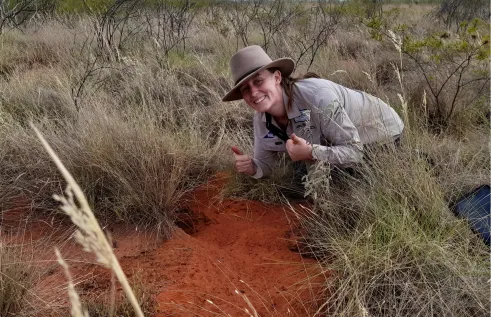
Producing practical recommendations for bilby conservation
Over a multi-year journey, Hayley Geyle completed a valuable PhD project focused on the ecology of the greater bilby. The work centred on improving understanding of the ecology, distribution, and abundance of the bilby in arid and semi-arid Australia, particularly in the NT which is one of the species’ last remaining strongholds.
Read more about Producing practical recommendations for bilby conservation
Preserving genetic diversity of endangered rabbit-rats
Bryn Pickering focused closely on brush-tailed rabbit-rats (Conilurus penicillatus) during his honours year. In particular, he aimed to evaluate the viability of a population of rabbit-rats that were translocated from mainland Cobourg Peninsula onto Greenhill Island, within Garig Gunak Barlu National Park in the NT.
Read more about Preserving genetic diversity of endangered rabbit-rats


