RIEL News
Professorial delegation discusses environmental protection and biodiversity in Beijing
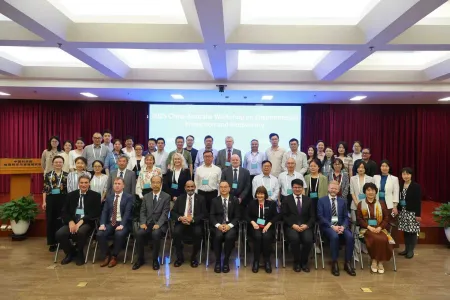
Charles Darwin University (CDU) academics were among a high-level Australian delegation that visited the Chinese Academy of Sciences (CAS) last month.
The group attended a joint CAS and Australian Academy of Science workshop on environmental protection and biodiversity, held at CAS’ Institute of Geographic Sciences and Natural Resources Research in Beijing on 2-4 June 2025.
The Australian delegation was led by CDU’s Research Institute for the Environment and Livelihoods (RIEL) Terrestrial Invertebrates Professor Alan Andersen, an internationally recognised ecologist whose research focuses on the global ecology of ant communities and also chairs the Australian Academy of Science’s National Committee for Ecology, Evolution and Conservation.
Delegates also included CDU’s RIEL Conservation Management Professor Sarah Legge, along with University of Sydney Professor Chris Dickman, Griffith University Professor Stuart Bunn, and James Cook University Professor Helene Marsh and Professor Susan Lawrence.
During the visit, the delegation was deeply impressed by China’s commitment to environmental sustainability, including biodiversity conservation. Professor Andersen remarked on quotes attributed to China’s President Xi Jinping that referred to unprecedented challenges in global environmental governance and called on the international community to show ambition, action, and unity to create an ‘ecological civilisation’.
“We saw during the workshop that this sentiment is being actioned by extraordinary investment in biodiversity research and conservation, including the creation of a staggering number of new national parks, along with biodiversity monitoring and ecosystem restoration at a scale that is unimaginable here in Australia,” Professor Andersen explained.
The delegates visited a range of CAS facilities, including the billion-dollar EarthLab, a virtual Earth laboratory that simulates “the physical climate system, environmental system, ecological system, solid earth system, and space weather system as a whole with a high-performance scientific computing platform.” The delegates found the simulation visualisations truly mesmerising.
“China’s commitment to, and investment in, science and technology, its world-leading capability, and the advances it continues to make are truly extraordinary. Australia needs to get on board,” Professor Andersen said.
“This is much more than fruitful opportunities for collaboration — collaboration with China needs to be seen as a national science priority.”
Funding opportunities are available for visits by international scientists and for collaborative research through the CAS President’s International Fellowship Initiative.
This article was originally published in CDU Uni News August 2025
Related Articles
Project examines fisheries and aquaculture work through gender lens
Nilanjana Biswas’s PhD project explores the under-researched role of women in the NT’s commercial seafood sector. Using a gender lens and mixed methods, it examines historical contributions, structural barriers, and policy impacts, making it one of Australia’s first studies in this field.
Read more about Project examines fisheries and aquaculture work through gender lens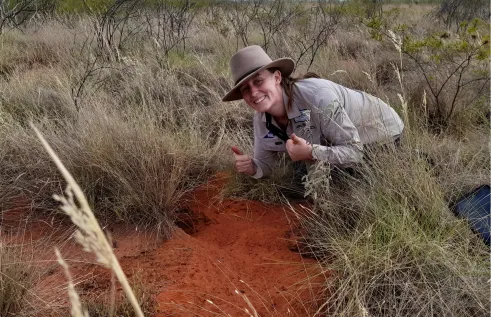
Producing practical recommendations for bilby conservation
Over a multi-year journey, Hayley Geyle completed a valuable PhD project focused on the ecology of the greater bilby. The work centred on improving understanding of the ecology, distribution, and abundance of the bilby in arid and semi-arid Australia, particularly in the NT which is one of the species’ last remaining strongholds.
Read more about Producing practical recommendations for bilby conservation
Preserving genetic diversity of endangered rabbit-rats
Bryn Pickering focused closely on brush-tailed rabbit-rats (Conilurus penicillatus) during his honours year. In particular, he aimed to evaluate the viability of a population of rabbit-rats that were translocated from mainland Cobourg Peninsula onto Greenhill Island, within Garig Gunak Barlu National Park in the NT.
Read more about Preserving genetic diversity of endangered rabbit-rats


