RIEL News
Scientists contribute to Tiwi Junior Rangers Program
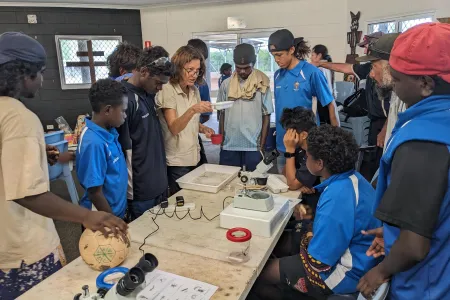
The Tiwi Junior Rangers Program is an important initiative helping Tiwi College students to engage with the Tiwi Islands’ unique environment and cultural heritage. In 2024, members of RIEL’s invertebrate biodiversity group contributed to the program by sharing environmental science skills with the junior rangers.
Over a series of four visits to Pickertaramoor on Melville Island in the Tiwi Islands, RIEL’s Prof Alan Andersen and PhD students Allyson Malpartida and François Brassard taught modules on botany, terrestrial insects, and aquatic biodiversity. They were supported by aquatic macroinvertebrate specialist Maryanne McKaige.
In the botany module, students learnt how to recognise features of different plants and how to classify them. The module also covered traditional names and uses of common Tiwi plants. The insect module focused on the roles of insects in ecosystems, and on insect classification and identification. Students sampled insects using sweep nets and pitfall traps, before sorting and identifying specimens in the lab. The aquatic biodiversity work involved testing water quality and sampling aquatic macro-invertebrates in a local creek, then looking at invertebrate samples and drawing food webs in the classroom.
“The students were fascinated by seeing so many different sorts of insects and other invertebrates, and for many it was their first experience with a microscope. A whole new world was opened up for them!” said Prof Andersen.
Tiwi senior Elders and rangers were involved in all the activities, as were Tiwi College teachers. The RIEL team delivered the modules in partnership with Tiwi College, Tiwi Resources, and Calytrix Communication. This impactful program is set to continue in 2025.
This story was originally published in the RIEL Annual Report 2024 (PDF, 4.08 MB).
Related Articles
Project examines fisheries and aquaculture work through gender lens
Nilanjana Biswas’s PhD project explores the under-researched role of women in the NT’s commercial seafood sector. Using a gender lens and mixed methods, it examines historical contributions, structural barriers, and policy impacts, making it one of Australia’s first studies in this field.
Read more about Project examines fisheries and aquaculture work through gender lens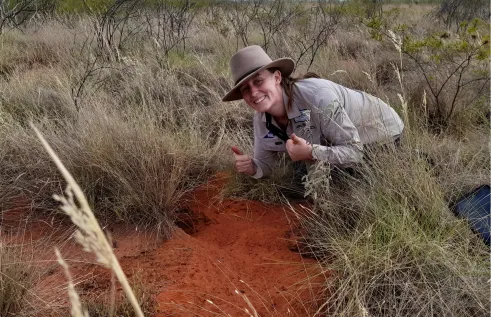
Producing practical recommendations for bilby conservation
Over a multi-year journey, Hayley Geyle completed a valuable PhD project focused on the ecology of the greater bilby. The work centred on improving understanding of the ecology, distribution, and abundance of the bilby in arid and semi-arid Australia, particularly in the NT which is one of the species’ last remaining strongholds.
Read more about Producing practical recommendations for bilby conservation
Preserving genetic diversity of endangered rabbit-rats
Bryn Pickering focused closely on brush-tailed rabbit-rats (Conilurus penicillatus) during his honours year. In particular, he aimed to evaluate the viability of a population of rabbit-rats that were translocated from mainland Cobourg Peninsula onto Greenhill Island, within Garig Gunak Barlu National Park in the NT.
Read more about Preserving genetic diversity of endangered rabbit-rats


