RIEL News
Supporting conservation efforts for pygmy blue whales
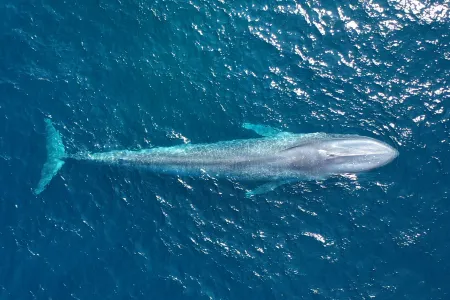
Blue whales are a global icon of ocean conservation. The waters of Timor-Leste, particularly the Ombai-Wetar Strait, are a hotspot for whales and dolphins, including blue whales. In particular, these waters are home to the smallest and only tropical subspecies of blue whale – Balaenoptera musculus brevicauda (pygmy blue whale).
While blue whales are listed as endangered, and commercial whaling has been banned since 1966, recovery of the species has been extremely slow. They remain highly susceptible to climate impacts, particularly ocean warming, and to the impacts of shipping, seismic activities related to oil and gas development, and ocean pollution. They are also highly elusive, with limited information available on their migratory routes and their feeding, calving and breeding areas – particularly in tropical waters.
In addition to this, Timor-Leste has become a major whale tourism destination over the past 10 years, particularly for ‘swim with whales’ tourism. While this industry provides major opportunities for Timor-Leste to help address critical poverty and economic development challenges, the industry is growing very rapidly and remains unregulated.
Dr Karen Edyvane, Adjunct Senior Research Fellow at RIEL, is leading a decade-long research and ‘citizen science’ monitoring program that is providing baseline information on the status, movements, behaviour and ecology of blue whales in Timor-Leste. This information is vital for conservation efforts, including threat mitigation and environmental impact and risk assessments for ongoing human activities. This work will also provide critical information to support Timor-Leste’s important whale tourism industry and sustainable tourism.
The program is run in partnership with local universities, fishing communities, government and whale tour operators in Timor-Leste, as well as blue whale researchers and conservation managers in Australia and globally.
This story was originally published in RIEL Annual Report 2024
Related Articles

Project examines fisheries and aquaculture work through gender lens
Nilanjana Biswas’s PhD project explores the under-researched role of women in the NT’s commercial seafood sector. Using a gender lens and mixed methods, it examines historical contributions, structural barriers, and policy impacts, making it one of Australia’s first studies in this field.
Read more about Project examines fisheries and aquaculture work through gender lens
Producing practical recommendations for bilby conservation
Over a multi-year journey, Hayley Geyle completed a valuable PhD project focused on the ecology of the greater bilby. The work centred on improving understanding of the ecology, distribution, and abundance of the bilby in arid and semi-arid Australia, particularly in the NT which is one of the species’ last remaining strongholds.
Read more about Producing practical recommendations for bilby conservation
Preserving genetic diversity of endangered rabbit-rats
Bryn Pickering focused closely on brush-tailed rabbit-rats (Conilurus penicillatus) during his honours year. In particular, he aimed to evaluate the viability of a population of rabbit-rats that were translocated from mainland Cobourg Peninsula onto Greenhill Island, within Garig Gunak Barlu National Park in the NT.
Read more about Preserving genetic diversity of endangered rabbit-rats


