RIEL News
Team examines Vibrio ecology in Darwin Harbour
Research has found that wet season and monsoon rain events are connected to an increase of potentially pathogenic Vibrio bacteria in tropical waters, which could affect human health through food sources.
David Simma, Dr Anna Padovan, Dr Mirjam Kaestli and Prof Karen Gibb, who are members of RIEL’s Bioscience North Australia (BNA) group, measured the spatio-temporal patterns of two marine opportunistic pathogens in a tropical estuary — in seawater, sediment, and an edible snail. The goal was to use the information to identify high-risk periods for human health in Darwin Harbour.
The work, which formed Mr Simma’s master by research in 2021–2023, was published and finalised in 2024. The results suggest that the wet season, and particularly times of extreme weather events when environmental conditions change rapidly, could be periods of high risk for vibriosis in tropical Australia, an area which is predicted to experience more frequent severe weather events into the future. Vibriosis is an infection caused by Vibrio bacteria.
“Pathogenic species of Vibrio have been called the ‘barometer of climate change’ and our work supported this claim,” said Prof Gibb. “More severe weather events are predicted in the monsoonal north and in our study a monsoon event coincided with an increase in two known Vibrio pathogens in artisanal harvest.”
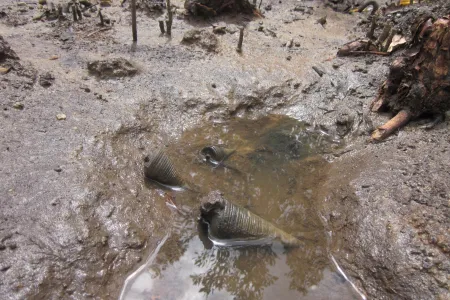
By including an edible snail — the Telescopium telescopium, or long bum snail, which is collected in the shallows by Indigenous peoples and lightly cooked or occasionally eaten raw – researchers could demonstrate accumulation in food rather than just water and sediment, which helped to show good eating times.
The research, which was funded by BNA and CDU’s Faculty of Science and Technology, also expands the current understanding of the factors driving the abundance of potentially pathogenic Vibrio species in tropical estuaries.
This story was originally published in the RIEL Annual Report 2024
Related Articles
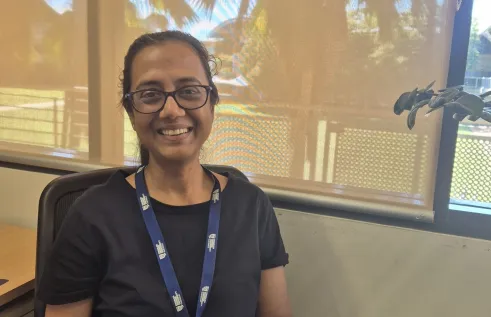
Project examines fisheries and aquaculture work through gender lens
Nilanjana Biswas’s PhD project explores the under-researched role of women in the NT’s commercial seafood sector. Using a gender lens and mixed methods, it examines historical contributions, structural barriers, and policy impacts, making it one of Australia’s first studies in this field.
Read more about Project examines fisheries and aquaculture work through gender lens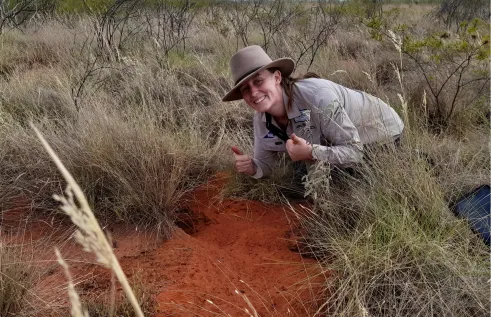
Producing practical recommendations for bilby conservation
Over a multi-year journey, Hayley Geyle completed a valuable PhD project focused on the ecology of the greater bilby. The work centred on improving understanding of the ecology, distribution, and abundance of the bilby in arid and semi-arid Australia, particularly in the NT which is one of the species’ last remaining strongholds.
Read more about Producing practical recommendations for bilby conservation
Preserving genetic diversity of endangered rabbit-rats
Bryn Pickering focused closely on brush-tailed rabbit-rats (Conilurus penicillatus) during his honours year. In particular, he aimed to evaluate the viability of a population of rabbit-rats that were translocated from mainland Cobourg Peninsula onto Greenhill Island, within Garig Gunak Barlu National Park in the NT.
Read more about Preserving genetic diversity of endangered rabbit-rats


