RIEL seminar series
HDR Talks
| Presenter | Alex Carey and Angga Rachmansah | |
|---|---|---|
| Date/Time |
to
|
|
| Contact person | E: RIEL.outreach@cdu.edu.au | |
| Location | CDU Casuarina Campus Yellow 1.1.39 and online | |
| Open to | Public | |
The use of spatial metrics in fire ecology presented by Alex Carey
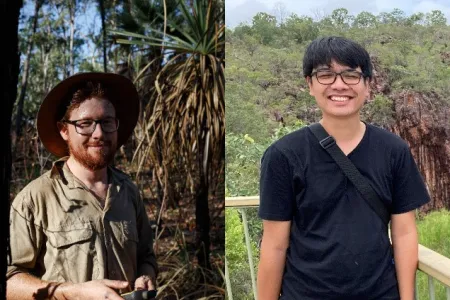
Alex is a PhD candidate with the Research Institute for the Environment and Livelihoods at Charles Darwin University who is currently pursuing genetic questions for threatened species conservation on the Tiwi Islands.
Through this presentation Alex will discuss how the spatial components of fire regimes have been understudied in comparison to the temporal and intensity components. This has been attributed to the difficulty in obtaining high-quality spatial data, the dominant focus on plants of low dispersal, and the overall difficulty of design and implementation. However, many of these limitations have faded in recent years with new technologies, experimental approaches, and a broad focus on plants, animals, and ecosystems. As a result many spatial metrics are now being used, leading to new, but potentially inconsistent, findings.
Alex will discuss a review that explored what spatial metrics of fire are being used, how they are defined, and what methods are employed to analyse the impact on populations.
(No video)
Lizard responses to experimental fire regimes in an Australian tropical savanna presented by Angga Rachmansah
Angga is a PhD candidate with the Research Institute for the Environment and Livelihoods at Charles Darwin University whose research interests lie in the ecology and conservation of amphibians and reptiles.
In this seminar Angga will show that fire is a primary disturbance agent that plays a key role in shaping biodiversity in savanna ecosystems. However, the effects of different fire regimes on a major faunal group in tropical savannas, lizards, are still poorly understood. This hinders the development of appropriate fire management for biodiversity conservation. A controlled fire experiment at the Territory Wildlife Park in northern Australia has been running for 20 years, providing an opportunity to study the long-term impacts of different fire regimes on lizards.
Angga will share the preliminary results of how lizards respond to the fire experiment and the possible mechanism that underlies their responses.
(No video)
Related Events

The Dr Bilawara Lee OAM (Aunty B), Faculty of Health Public Lecture
Bernard Salt explores how the aging baby boomer generation and a post-pandemic shift toward wellness will drive unprecedented demand and consumer expectations within Australia’s healthcare sector and "care economy" through 2036.
Read more about The Dr Bilawara Lee OAM (Aunty B), Faculty of Health Public Lecture
Freedom of Political Communication and Social Cohesion
The 15th Austin Asche Oration features The Hon. Justice Marcus Solomon SC, who will examine how debates surrounding free speech, rising prejudice, and declining social cohesion are reshaping Australia's legal and political landscapes.
Read more about Freedom of Political Communication and Social Cohesion
NT Art Awards Guided Tour
The Midpul Art Gallery is hosting a guided tour of the NT Art Awards that invites viewers to explore the creative processes and material choices of 72 diverse artists to gain a deeper perspective on their work.
Read more about NT Art Awards Guided Tour


