RIEL News
Research highlights new possibilities for detecting invasive plants
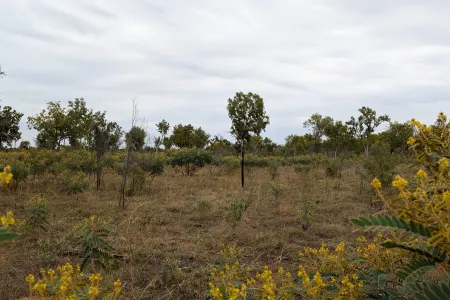
Researchers from Charles Darwin University (CDU) have conducted an in-depth review of the use of satellite radar technology for monitoring invasive alien plants, shedding new light on the underutilised role of synthetic aperture radar (SAR) in this critical area of environmental management.
The paper, A Review of Spaceborne Synthetic Aperture Radar for Invasive Alien Plant Research, authored by Glen Shennan and Dr Richard Crabbe from the Research Institute for the Environment and Livelihoods (RIEL) at CDU, reveals important trends in the use of SAR for invasive plant detection.
SAR technology, known for its ability to penetrate cloud cover and operate in all weather conditions, offers significant advantages in monitoring invasive plants. However, the review found that SAR remains underrepresented in research compared to more traditional optical remote sensing methods.
“Our review highlights the promising capabilities of SAR, especially in scenarios where invasive plants exhibit distinct structural differences from their surroundings, such as when invasive species displace native vegetation in wetlands,” Mr Shennan said.
One example relevant to northern Australia, though not discussed in the paper, is gamba grass (Andropogon gayanus). Gamba grass is a highly invasive species characterised by tall, dense growth, which contrasts with the shorter, sparser native grasses it tends to displace.
These structural and morphological differences create a unique opportunity for SAR-based detection, offering the potential for novel monitoring and management strategies.
The review also emphasised the growing importance of combining SAR data with optical and multispectral sensors to improve detection accuracy.
“Data fusion techniques that merge SAR with multispectral data are showing increasing potential, but SAR’s full capabilities, particularly through advanced methods, have yet to be fully exploited,” said Mr Shennan.
The findings of this review offer a foundation for future research, and the authors hope it will stimulate increased interest in leveraging SAR technology for biodiversity protection in Australia and globally.
Mr Shennan and Dr Crabbe are now applying SAR techniques to study savanna vegetation and fire regimes on the Dampier Peninsula in Western Australia as part of the Australian Government’s Innovative Biodiversity Monitoring grant scheme.
The ability of SAR to distinguish different vegetation structures—such as trees, vines, and grassland—makes it particularly valuable for this project.
The detailed mapping of these vegetation types is crucial for understanding how fire regimes interact with and influence the complex savanna ecosystems in this region.
The review was published in Remote Sensing Applications: Society and Environment in September 2024.
This story was originally published in CDU Uni News November 2024 edition
Related Articles

Project examines fisheries and aquaculture work through gender lens
Nilanjana Biswas’s PhD project explores the under-researched role of women in the NT’s commercial seafood sector. Using a gender lens and mixed methods, it examines historical contributions, structural barriers, and policy impacts, making it one of Australia’s first studies in this field.
Read more about Project examines fisheries and aquaculture work through gender lens
Producing practical recommendations for bilby conservation
Over a multi-year journey, Hayley Geyle completed a valuable PhD project focused on the ecology of the greater bilby. The work centred on improving understanding of the ecology, distribution, and abundance of the bilby in arid and semi-arid Australia, particularly in the NT which is one of the species’ last remaining strongholds.
Read more about Producing practical recommendations for bilby conservation
Preserving genetic diversity of endangered rabbit-rats
Bryn Pickering focused closely on brush-tailed rabbit-rats (Conilurus penicillatus) during his honours year. In particular, he aimed to evaluate the viability of a population of rabbit-rats that were translocated from mainland Cobourg Peninsula onto Greenhill Island, within Garig Gunak Barlu National Park in the NT.
Read more about Preserving genetic diversity of endangered rabbit-rats


