RIEL News
New designs hit the water for environmental research and maritime training
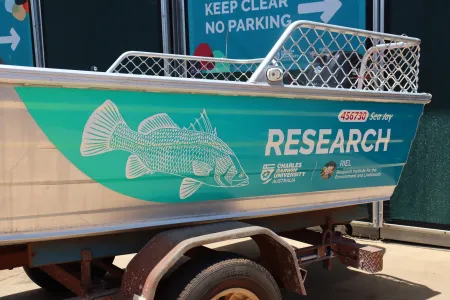
A refreshed fleet of three research-specification vessels is ready to hit the water in Darwin.
At Charles Darwin University’s Research Institute for the Environment and Livelihoods (RIEL), which is home to CDU students and staff working across the environmental sciences, teams regularly visit freshwater, estuarine, and marine ecosystems.
Their work looks at aquatic biodiversity and environmental management in river systems, wetlands, and coastal environments across northern Australia, which can involve sharks, turtles, whales, dolphins, crocodiles, and more. Safe and reliable vessels are among the many essential tools for researchers carrying out this critical work.
RIEL’s vessels have recently been freshened up with a clean, new look in readiness for the coming years. The new boat wraps not only provide long-term protection to the hulls and fulfil special signage requirements for research vessels, but have also been designed with a deep respect for local wildlife in mind.
The largest and newest of the three boats, 5.4-metre Manbiri, now features a design of a green turtle. The 5.2-metre Tyeyu displays a speartooth shark, while the smaller 3.98-metre Seajay features a barramundi.
The impressions of these three species were created by CDU environment student and linocut artist Kjell Hensen, who brought both creative talent and scientific knowledge to the project. His prints were later incorporated into the overall designs for the wraps created and installed by local signwriter, Lorna Wauchope.
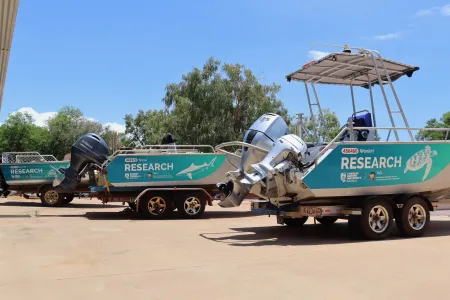
Manbiri was named in 2024 following discussions between RIEL researcher Natalie Robson, Garngi Rangers coordinator Bryan Macdonald, and rangers Clayton Chainsaw and Sonny Wauchope. Manbiri is the Iwaidja name for a green turtle.
The Garngi Rangers are based in Minjilang on Croker Island. Ms Robson and RIEL’s Dr Carol Palmer are involved in an ongoing Australian Marine Parks research project relating to turtles and cetaceans in the area.
The name Tyeyu was chosen in 2015 when RIEL’s Dr Peter Kyne was conducting research on the Daly River. After discussing with the local ranger coordinator and rangers, the team approached a senior Malak Malak Traditional Owner and asked if he would like to name the boat in recognition of the research collaboration. This led to the choice of the word tyeyu, which means shark in Malak Malak language.
At that time, the team was working extensively from the Kimberley to Kakadu on river sharks and sawfishes. Collaborative work continues until now in the area, with annual sawfish surveys taking place in the late dry season each year.
RIEL’s vessels are used by students and staff conducting externally funded research projects relevant to fisheries and environmental management. They are also used for CDU TAFE’s maritime training. In future, the vessels may also be available for external bookings.
Organisations wishing to explore options for small research vessels in Darwin can contact riel@cdu.edu.au for more information.
This story was originally published in CDU Uni News March 2025
Related Articles
Project examines fisheries and aquaculture work through gender lens
Nilanjana Biswas’s PhD project explores the under-researched role of women in the NT’s commercial seafood sector. Using a gender lens and mixed methods, it examines historical contributions, structural barriers, and policy impacts, making it one of Australia’s first studies in this field.
Read more about Project examines fisheries and aquaculture work through gender lens
Producing practical recommendations for bilby conservation
Over a multi-year journey, Hayley Geyle completed a valuable PhD project focused on the ecology of the greater bilby. The work centred on improving understanding of the ecology, distribution, and abundance of the bilby in arid and semi-arid Australia, particularly in the NT which is one of the species’ last remaining strongholds.
Read more about Producing practical recommendations for bilby conservation
Preserving genetic diversity of endangered rabbit-rats
Bryn Pickering focused closely on brush-tailed rabbit-rats (Conilurus penicillatus) during his honours year. In particular, he aimed to evaluate the viability of a population of rabbit-rats that were translocated from mainland Cobourg Peninsula onto Greenhill Island, within Garig Gunak Barlu National Park in the NT.
Read more about Preserving genetic diversity of endangered rabbit-rats


